Our first entry of 2013 is about last year's books. In December magazines and newspapers published their best-book lists. Digital Book World also announced the best-selling ebooks of the year. The most popular: theFifty Shades trilogy, followed by the Hunger Games trilogy. Surprise: the critics' preferences were different form the public's choices, none of these titles appear in their lists.
Not that there are many coincidences among the critics, but let me write about one of them: Hillary Mantel's Bring Up the Bodies, winner of the 2012 Man Booker Prize. What's special about her is that she also won the Booker Prize in 2009 for Wolf Hall(available at our library).She can add these to a long list of awards, which includes more than a dozen.
Wolf Hall and Bring Up the Bodies are part of the Thomas Cromwell Trilogy, about King Henry VIII's secretary. Cromwell helped the king break with Rome and marry Ann Boleyn. If you think you've had enough of Henry VIII, give it a try: you won't be disappointed. Both books are wonderful psychological portraits and an opportunity to learn about life in those years. There's a lot of intrigue, too, so you won't get bored. Cromwell himself is a fascinating character, a corrupt highflying type that is so popular on film and TV these days.
As you probably know, "In a hole in the ground there lived a hobbit." Once Tolkien had written this sentence on a blank examination paper he was marking, he decided that he had to find out what sort of hole he lived in, why he lived in a hole, etc. The result was a tale that was later published in 1937 with immediate success. It tells the story of how Bilbo Baggins, a respectable hobbit, had an adventure and found himself doing and saying things altogether unexpected. This is quite unusual, since respectable hobbits never have adventures or do anything unexpected. And a big adventure it is: he'll have to deal with trolls, goblins, the Gollum and even a fearsome dragon; he'll also find a certain ring with amazing powers. Fortunately he'll have the invaluable help of Gandalf the wizard and a group of dwarves with funny names.
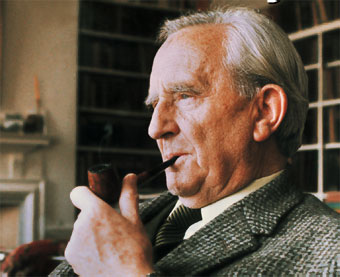
JRR Tolkien
What do hobbits look like? They are a little people, about half our height, and have no beards. They are inclined to be fat in the stomach; they dress in bright colors (chiefly green and yellow); wear no shoes, because their feet grow natural leathery soles and thick brown hair; have good-natured faces, and laugh deep fruity laughs (especially after dinner, which they have twice a day when they can get it).
The Hobbit is an utterly enjoyable story with lots of action and humour. It's like a fairy tale for smart children: the heroes are not quite perfect - their motivations not quite heroic; they are affected by cold weather, lack of food and difficulties; the outcome is a lesson in geopolitics. Bilbo gradually develops self-confidence, courage and good judgement; at the end he'll be a stronger, better person.
The Hobbit is soon to be added to our library. Meanwhile you might want to see Peter Jackson's first part of a trilogy of films, which opens worldwide today: I hope they're as good as the book!
Jennifer Egan's A Visit from the Goon Squadwon the 2011 Pulitzer Prize for Fiction, after receiving rave reviews when it was published. It is a collection of linked short stories that tell us about the pretty messed up lives of different characters at different times, past and future. They are more or less closely related and converge at different moments. Some are beyond redemption but there's hope for others.
Goon squads were originally groups of violent thugs who would beat up anyone opposed to certain labor unions and corrupt political machines. As one of the characters says: 'Time's a goon, right? You gonna let that goon push you around?'. This is the main theme in the novel, how time and circumstances shape people's lives.
Now, it might seem like a dark, depressing book, but actually it isn't boring at all: it's fast-paced and there are funny stories too, like the one about the public relations manager who represents a dictator. A particularly touching story -my favorite- is just a slide presentation! The last story describes a future in which the music industry is driven by toddlers.
This is definitely a good read and I highly recommend it. Of course, it is available at our library.
I'm pretty excited. Later this month opens Life of Pi, based on the wonderful novel by Yann Martel. Born in Salamanca of Canadian parents, Martel won the 2002 Man Booker Prize for Life of Pi, which was translanted into 40 languages and stayed in The New York Times Best Seller List for 57 weeks.
In the story, Pi Patel's family own a zoo in India but decide to emigrate to Canada. Unfortunately, the ship where they're travelling along with their animals sinks and 16-year-old Pi is stranded in a lifeboat for 227 days. His only companion, a Bengal tiger.
Pi's real name is Piscine Molitor, after a famous swimming-pool in Paris. With a name like that, you can expect he has trouble at school, so when he changes schools he decides to go by the name of Pi, as in the number. However his plan backfires, as his classmates then call him 'lemon pie.'
The film is directed by Ang Lee, winner of an Oscar for Brokeback Mountain and nominated to another for Crouching Tiger, Hidden Dragon; he's also responsible for the very successful Sense and Sensibility. With these credentials one expects a brilliant movie, and it certainly looks spectacular, as you can see in the trailer.
Just before the summer holidays, as we were all busy with final exams, legendary science-fiction writer Ray Bradbury died at the age of 91. Author or 27 novels and more than 600 short stories, he was one of the most popular writers in the world. Many of his works have been adapted into television shows or films, including Farenheit 451 by François Truffaut in 1966, and The Martian Chronicles, a collection of short stories - both available in our library. Among many other awards, Bradbury received the National Medal of Arts, presented by President George W Bush, and the Ordre des Arts et des Lettres. He was also given a star on the Hollywood Walk of Fame and this year's landing site of NASA's Mars Rover was named Bradbury's Landing. The Martian Chronicles is about the colonisation of Mars by humans escaping a devastated Earth, and the conflict between aboriginal Martians and the colonists. First published in 1950, it is curious to see how the future - now - was imagined more than half a century ago. As an example, see this prune advertisement featuring Mr Bradbury. You can read a short excerpt here. Farenheit 451 presents a future USA where books are outlawed and firemen burn any house that contains them. Read this short article describing the circumstances in which it was written - on a rented typewriter at a public library. Also, here's the film trailer.
I hope you all had a good summer. I'm back to the grind and I found this article: why should you go to your public library? The answer may seem obvious, but if you had to list 10 reasons what would you say? Just to brush up on your English you can follow the link and see if it mentions your ideas (you might be surprised by the webpage).

01.jpg/501px-Cromwell,Thomas(1EEssex)01.jpg)

 came the later lower.
 as it gets cold and gray falls from the air